Thursday, December 3, 2015

What got you into Gardening?


What got you into gardening?


When I was a young lad people would ask me what I wanted to be when I grew up. My reply was to be wise. People asking were expecting me to say an exciting job like fireman but for me being able to say the right thing at the right time to someone was my aspiration. 

Before my teenage years I actually thought that anyone over the age of about twenty were automatically wise and had not only the answers to all of life’s problems but also didn’t make mistakes as they had done them all before the end of their teenage years. There was a part of me that was directionless and unambitious and this came into play because I thought the only think I had to do to be full of worldly wisdom, advice and answers, was to come out of my teenage years and have an easy ride the other side. 

It wasn’t too long before I realised that to be good at anything you have to put in a lot of time and energy and to in a position of worldly wisdom you have to keep making mistakes and learning from them as well as being caring and a good listener. 

I eventually concentrated my time and energy to growing plants, and maybe after spending thousands of hours doing gardeny things, I might have developed a bit of plant wisdom, but certainly not when it comes to people, that’s  different thing altogether. 

If anyone comes for life tips and advice I tend to laugh at inappropriate times, keep a silly grin on my face, come out with totally unrelated topics and suggest they talk to Julie as I slowly walk backwards to the door. If I can’t change the conversation to plants then I’m lost. After saying that not all of my words of wisdom are of any use in the garden either, there was that time I told someone to put garden slugs in the bin (about 100 of them). They did just that, putting them alive in their kitchen bin (not the wheelie bin outside) only to be greeted with them all over the house for the next few weeks. I’ll stick to gardening and leave the wisdom bits to Julie, she’s a better listener than me, I just usually wait for the other person to stop taking so I can talk about vegetables. 

And talking of vegetables….

Garden Influences
I was asking a few people about what got them started in a lifelong love of gardening, it could be something as simple as rooting a cutting in a jam jar. I asked if there was a particular person that influenced them in this wonderful hobby.

 Here are a few of their answers:
Lona:  My mother loves to grow flowers, but I'm more practical...I like a "reward" for my efforts! Mam and I live together so the compromise was I would keep planting the flowers she loves (She's almost 84) if she would share her knowledge of vegetables.

Eric Beuning: When I was growing up my mam worked a lot of double shifts. So I was essentially raised by an old Italian woman next door. She taught me the garden to plate philosophy she grew up with in Naples. She also ran a restaurant during her working life so she taught me how to do a lot of things in the kitchen. She had no children of her own. So I'm the only keeper of her heirloom seeds and recipes. Now I teach these things to my two and a half years old daughter.

Ramona :  My mother always had a huge garden and when I was young, she would have me help her. Although I grouched about helping her, I did like the one-on-one time with her. 

Paul : I remember going to my mams parents as a kid and they always had a nice garden.
Elaine: My dad. Some of my best times with him were planting seeds and pulling weeds. He was my inspiration and I always think of him when I am 'playing' in my garden.

Linda:  It was my mam. I was a bit of a surprise baby and the other kids were older. I had a delightful first 5 years when all the others were off at school I had her to myself. I remember many hours spent in the garden, planting seeds, picking raspberries to have on my cereal in the morning.

Jeff: My influence is my grandfather. It's actually my father who tells the stories about how they grew up gardening and living off the land. My grandmother preserved hundreds of jars of food before fridges. The stories I've been told and what I saw when we visited over the holidays, really sparked my interest. I picked it up as a young teenager and still going at it 43 years later. I hope one of my grandchildren inherited this gene and I become that person in their lives someday. If I was doing a scientific study, I bet our gardens keep us emotionally tied to these people, giving us a much healthier outlook on life.

Thursday, November 26, 2015

Baking Soda in the Garden


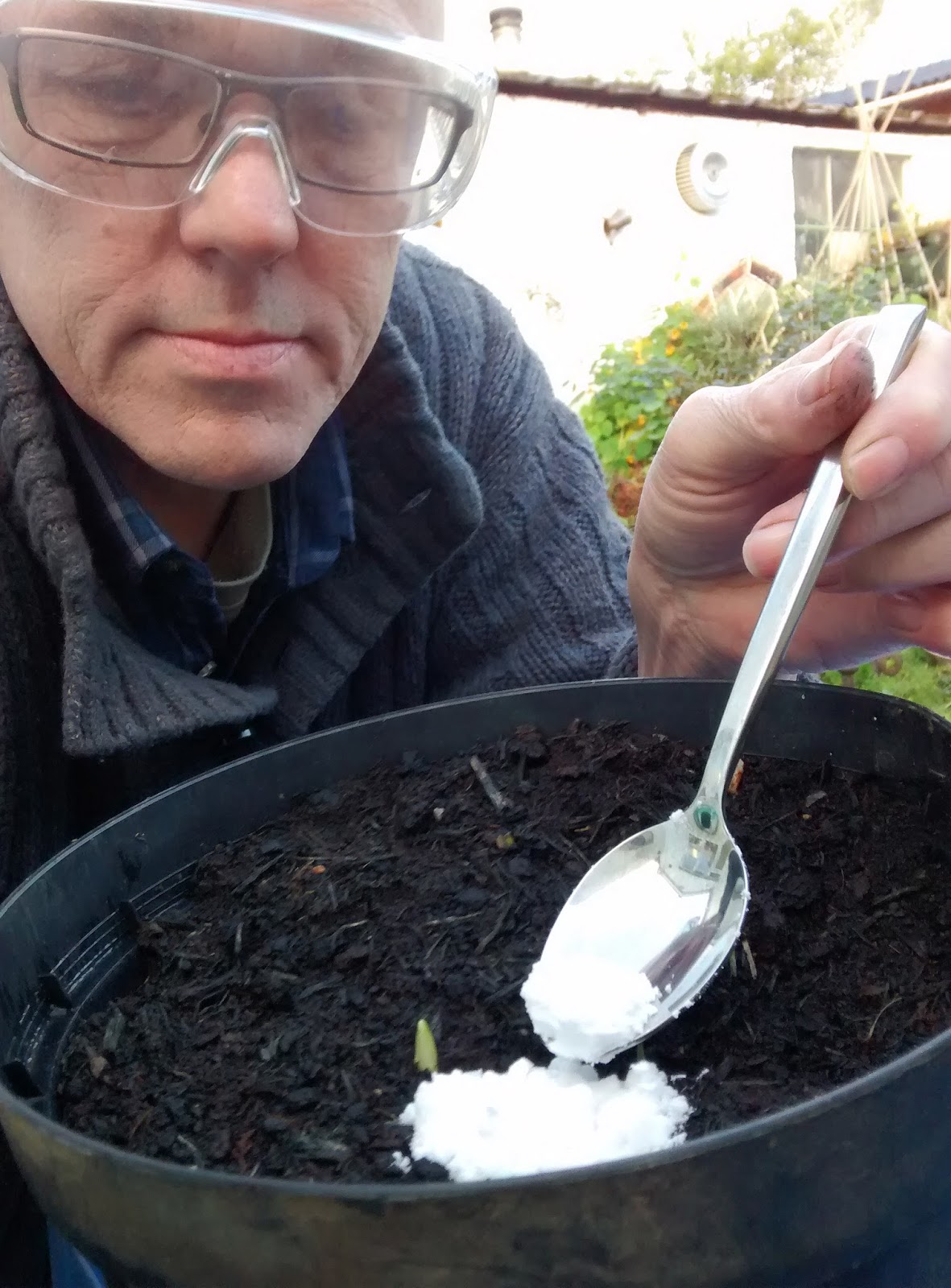
Checking to see if the soda bubbles!
 
Gardening is a funny old business. Many is the time the lines between gardening and other domestic pursuits are blurred, especially in the kitchen.  

Is emptying the vinegar out of my pickle jars onto weeds gardening, or recycling the kitchen waste, or both? Then there’s cooking, is that just an extension of tending vegetables?
Sometimes I think too much. 

One thing that I do know is that a lot of items in the kitchen cupboards can be used for pest and disease control and if used correctly could do away with buying any garden chemicals. I’ve mentioned vinegar, but what about Bicarbonate of Soda? I’ve been looking through old articles and apart from using it to whiten teeth, clean ovens, freshen carpets and pet beds, stripping paint and cleaning toilets, I can’t see that I have ever mentioned it’s virtues in the garden. Until now.

Baking Soda
Baking soda is an absolute 'must have' in the garden and it’s very cheap to buy if you get the non-brand named packets in the baking area of the supermarket. It’s a natural product but should still be used with caution. Here are some of the things we can be doing with this white powder. Just to clarify, baking soda is the pure Sodium Bicarbonate and baking powder is soda with added ingredients like cream of tartar for cooking.

Make a Spray to Prevent and Treat Powdery Mildew.
Powdery mildew can be a problem for many plants. Plants prone to damaging powdery mildew include cabbages, tomatoes, potatoes, pumpkin, melons, cabbage, squash.
Cucumber and squashes are particularly susceptible powdery mildew which can eventually affect the plants immune system and kill it off. A simple mixture of baking soda, water, and washing liquid can really save your cucumber crop or deter the mildew from even happening.
Invasive Caterpillars
Sprinkle Baking Soda on cabbages (and other Brassicas) to stop caterpillars, aphids, ants, silver fish and some beetles. Put directly onto slugs to kill them.
Cabbage Worms
Make a 50/50 combination of flour and baking soda, and dust it all over whichever plants the cabbage worms are eating. The mixture is good for most vegetable plants particularly cabbage, broccoli, and kale plants which caterpillars love. Repeat as necessary if the mixture is washed off.
More Ideas
Paving Cracks. Simply pour or sweep a thick layer of baking soda into patio cracks. The baking soda will kill any small weeds that are already there, and prevent new ones from sprouting.
Tomato Sweetener – Some say sprinkling baking soda onto the soil around the plants sweetens the fruit.
Rabbit Deterrent - Sprinkle baking soda around your garden to keep the rabbits from eating your herbs and veggies.
Control Postharvest Diseases on fruits.  Baking soda is more effective when combined with yeast organisms that prevent diseases from growing than expensive chemicals.
Clean Garden Tools.  Baking soda is the perfect abrasive to clean all of the gunk and organic build-up on your garden tools.
Keep Seeds Dry. Keep an envelope, box, sash, or what have you of baking soda inside of your seed box to keep your seeds dry.
Clean Nails & Cuticles. All gardeners have at least one thing in common and that’s dirty fingernails and feet. For soft, clean nails without a trip to the manicurist, simply dip your hands and feet in a bowl of warm water mixed with baking soda.
Clean Fruits and Vegetables . Add 2 tablespoons of baking soda and a drop of vinegar to a bowl of water to clean fruits and vegetables. Rinse well afterwards.
PH level. Wet soil and take a small amount of baking soda and sprinkle onto soil, apparently if it bubbles your soil is acidic with a PH level under 5.
Black Spots on Roses. Mix 1 Tbsp. of baking soda and 1 tsp. of washing up liquid in a bucket of warm water. Spray on roses every ten days to prevent and treat black spot disease.
Keep cut flowers fresh longer by adding a teaspoon to the water in the vase.
Soak dried beans to a baking soda solution to make them more digestible.
Rubber Gloves. Trouble getting on rubber gloves? Just sprinkle in some baking soda and they’ll slip right on.
Baking Soda kills moss and slimy green / black stains. Baking soda isn’t harmful to the rest of your lawn and plants, but it will cause lawn moss to turn brown and die within a week. Baking soda mixed with either water or vinegar to make a thick paste will completely get rid of moss / fungal stains.
Remove labels from garden pots and garden decorations . There's nothing worse than buying a beautiful ceramic garden pot, pretty patio accessories or dishes for your next bar-b-que and you can't seem to remove that pesky price tag or manufactures label. Here's a homemade sticker remover that will save you money from having to buy a professional adhesive goo remover. Mix 1/3 cup baking soda and 2/3 cup of vegetable oil. It works every time. And you don’t even need to get the WD40 out.

Friday, November 20, 2015

Guerrilla Grafting


Urban trees can be beautiful and a hazard


Apparently up to 80% 0f the population have never used a road map when traveling in the car. Satellite navigation became popular in the nineties and it looks as though there are a lot of younger drivers on the road who started with a clunky screen on their dashboard and have progressed to using their phone to find a destination.

I’m one of those people that ‘progressed’ from the Collins road atlas straight to a phone and as handy as it can be they are not perfect (some say it’s me but I am in denial) Last week I headed down to Enniskillen and set the map to my location before setting off.  The default setting is to take the fastest route and what a route I went. I was taken down onto tiny single track roads more suitable for tractors. If my phone battery went I would probably still be there trying to miss the potholes.  Without the navigation taking me off the beaten tracks I’m sure I wouldn’t have seen as many beautiful autumn tree colours. Farmers along the route have done a wonderful job of planting colourful native and non-native trees along the roads and fields. A real joy to behold.

Guerrilla Grafting
Planting trees doesn’t always get a seal of approval though. Every year in urban areas the councils are usually inundated with complaints about fallen leaves causing a hazard , either by clogging up gutters or being slippery.  In contrast there is a group who thinks that urban trees are a really underused source of food and like guerrilla gardeners who go around planting vegetables in city centre roundabouts and throwing seed bombs, they are heading out and grafting fruit stock onto ornamental tree branches. 

The group of fruit lovers in San Francisco call it “guerrilla grafting” they graft fruit bearing branches onto fruitless, ornamental trees.

In many built up areas, councils make sure that flowering fruit trees don’t bear any fruit, in order to keep fallen fruit from making a mess on pavements and attracting vermin. Most public trees are fruitless, a fact that the Guerrilla Grafters obviously don’t like. While authorities see urban fruit-bearing trees as a nuisance, these agricultural rebels see them as an opportunity to provide fresh, healthy produce for free to anyone who walks by.

Noble Gesture
One member on their facebook page tells us “Guerrilla Grafters is a grassroots group that sees a missed opportunity for cities to provide a peach or a pear to anyone strolling by. Their objective is to restore sterile city trees into fruit-bearers by grafting branches from fertile trees. The project may not resolve food scarcity, but it helps foster a habitat that sustains us.” Their mission, they say is to make delicious, nutritious fruit available to urban residents through these grafts.
It is a noble gesture but guerrilla grafting is illegal and classified as vandalism by San Francisco’s Department of Public Works, but unless someone is caught in the act, there’s not much the police can do.  Apparently it is hard to catch anyone because it’s hard to know what an illegal graft looks like; maybe it’ll be like a fingerprint in future as everyone will develop a particular style.

However, some people seem to think guerrilla grafting is a very serious problem. “It gets very dangerous very quickly,” said Carla Short, an urban forester for the San Francisco Department of Public Works. “I mean the minute that fruit gets crushed on the sidewalk, it is slippery. We certainly don’t want people to get injured.”

The intention of doing guerrilla grafting is, says a member, not so much for the sake of challenging authority, but to set a working example. Plus they promise, every grafted tree has a steward, someone who promises to check up on it regularly, making sure it doesn’t cause any problems. How this will pan out on a legal basis is yet to be decided. Does a ‘steward’ have a legal obligation and what if someone put in a claim against them? 

Many fruit lovers in California do try “legal channels” One member wanted to plant a fruit tree in front of her house and was fully prepared to care for it herself. But her efforts were repeatedly thwarted by the department and by San Francisco non-profit Friends of the Urban Forest. So she began connecting with other frustrated residents who wanted fruit trees and they started using social media to delve into underground channels.

Movement member Tara Hui says “The hope is that through this one small act (of grafting) we can reconnect with a shared space and reconnect with each other.” Ultimately, I think codes and regulations should respond to the reality of people’s lives. Just taking an evening stroll, and then you see a fruit and you reach over and now you’re nourished.” Unless of course you slip up on it covering your clothes with ripe fruit and get stung by wasps. In a lot of towns, pavement slabs are taken up and replaced with asphalt because of insurance claims, so I can’t see many ‘grafters’ around here just yet.

More stories

Related Posts with Thumbnails