Tuesday, December 5, 2017

Garden Crafts - For a bit of winter colour


 Painted raised beds at Barrack Hill in Carndonagh

I was recently at the Guildhall fair having a look at local handmade crafts.

I wasn’t there to buy anything, (I leave that part to Julie) for me it’s more an opportunity to wander around and think “I could make that” , then come home bursting with creativity, eager to emulate a cut price festive present made from sticky backed plastic and an egg box. 

I’m getting a bit of a reputation in the family with my budget crafts. Last week my lad bought himself a long cylindrical floor standing lampshade. When I saw it my first reaction was “I could make that” to which he replied that he wouldn’t want a shade made out of old toilet roll tubes and Quality Street wrappers. I’m sure he doesn’t, but I actually think that sounds like a good idea.

There were a lot of very professional items at the fair but also a lot of things that any of us could make with a bit of glue, paint and imagination; I particularly liked the mussel shells, driftwood and sea glass made into pictures of flowers.  The shells were the petals, the glass the centre of the flower and the driftwood was the stem. It’s the sort of thing you could make and leave on the beach for the next person to find and probably destroy in much the same way someone else’s sandcastle creation is when it’s found by a youngster.  

I do enjoy fleeting temporary pieces of art and this is probably why I enjoy growing plants and gardening so much. Every day, week and year are different in the garden when ever changing colours and designs come to play. If you have ever been away for a week or two in summer and been amazed at how different the garden looks you’ll know what I mean.

If you do get a bit of time on your hands or feel yourself getting enthusiastic and motivated to make something for yourself or as a present then read on. 

I generally start by making something elaborate like a lamp base made from concrete or peat with the lamp shade made from coffee grounds and when it doesn’t work and I’ll just say it’s a garden ornament and add it to my collection of rubbish accumulating in the garden. 

That way there are no failures and as the rain washes the coffee into the ground from the shade I can say that it’s a slow release fertilizing machine to drip nutrition back into the soil. It’s a win win situation.

Let’s get Creative

There are things we can put in the garden to brighten things up over the coming darker months and most of them will be totally frost hardy, all we need is a touch of bright coloured paint.

Wind Howlers. These are a variation on a windchime. Cut strips from plastic bottles, paint brightly and put up on trees. They will howl every time there’s a gust of wind. I’ll give you two days until they are taken down but fun for a few minutes.

Make a Giant Allium. All you need is the bright paint, a hard ball and some 4” nails. Tap the nails into the ball leaving most of the nail sticking out, paint and put on a stick. Gaint magic flowers all winter (you might need to check google for an image to clarify)

Paint up the old wheelbarrow bikes or car tyres. You don’t even need to add flowers if you splash enough paint on it.

Spray car wheel trims you find on the side of the road. These can be then stuck to the garage wall outside and add a few bamboo canes from the base and these will look like stems.

Form balls with chicken wire and paint these bright colours. Stick on bamboo poles and scatter around the garden.
 
Plastic jar and bottle tops. Barrack Hill Town Park and Community Gardens in Carndonagh have probably made the brightest and boldest addition to their gardens with lovely painted raised beds. Some don’t even have paint, they have screwed hundreds of plastic jar tops onto one of their raised beds. So many colours, you could almost see them from space.  They have 8 boxes being decorated by the different schools in the area which will be planted with spring bulbs as part of the nectar cafe project, part of the ECO Inishowen project with IDP, funded thought the EU LADDER program so hope to have loads of pollinators in the summer.

Be mindful not to go overboard with the paint or to leave them there until all the colour disappears. The garden will then have turned from a glorious haven for bright and cheery creativity into my garden. A dumping ground for lots of rubbish. I wouldn’t have it any other way though, although I do need a tetanus jab every year.

Tuesday, November 28, 2017

Virtual Gardening and Drones


I’m often accused of being on another planet. This week you could say I have been in another dimension. 

My lad got himself one of those virtual reality headsets to play with and I have spent a bit of time with it over my head.  All in the name of research of course. There’s a comfortable headset, motion controllers, and external sensors for setting up a virtual room. These allow full 360 degree viewing which makes for a most realistic experience. I am able to move around the room without going out of range and hitting anything solid. You do really feel part of the VR world and so far I have sliced hundreds of watermelon and cabbages and built a few brick walls with an all-enveloping game of Minecraft.

Virtual reality headsets have been used effectively for high end property developments both for the investors and the end purchasers to use before parting with cash. It’s not going to be too long until these systems are used on landscape design. The system is already here for us to fly drones over gardens taking in all of the dimensions and terrain, there’s actually an app that could do that for us. This information can be fed into a design program where the landscaping ideas for the customer can be fed into and then this information can be digitally enhanced for 3D headsets.  Customers can actually feel what it will be like to be in their new garden and if my lad has anything to do with the programming it’ll also include a sword for you to be able to chop off all of the daffodils and gain points as you walk along.

Drones
Drones are becoming increasingly popular. The ability to have an HD camera on it has revolutionized filming (every TV programme has that cinematic feel to it now) There was a time when estate agents had to hire someone at great cost with a camera strapped to a helium balloon on a still windless day to float over a property to get an aerial view. Now this can be done any time for under €40 and you get to keep the camera and drone. 

Drones can do more than spy on the neighbours, film local landmarks and scare dogs on beaches though. They are starting to be used in a lot of horticultural and agricultural related ways. Aerial vehicles without pilots (UAV’s) have been used since the 1980’s and newer data gathering software is claiming to revolutionise the industry. Some agricultural producers are embracing strategies for producing food, increasing productivity, and making sustainability a priority. Drones, it is said, are seen to be a part of the solution, along with closer collaboration between governments, technology leaders, and industry.

Ways aerial and ground-based drones could be used in agriculture and horticulture:

Soil and field analysis: Drones can be instrumental at the start of the crop cycle. They produce precise 3-D maps for early soil analysis, useful in planning seed planting patterns. 

Planting: Startups have created drone-planting systems that achieve an uptake rate of 75 percent and decrease planting costs by 85 percent. These systems shoot pods with seeds and plant nutrients into the soil, providing the plant all the nutrients necessary.

Crop spraying: Distance-measuring equipment—ultrasonic echoing and lasers enables a drone to adjust altitude as the topography and geography vary, and thus avoid collisions. Consequently, drones can scan the ground and spray the correct amount of liquid, modulating distance from the ground and spraying in real time for even coverage. The result: increased efficiency with a reduction of in the amount of chemicals penetrating into groundwater. 

Irrigation: Drones with hyperspectral, multispectral, or thermal sensors can identify which parts of a field are dry or need improvements. Additionally, once the crop is growing, drones allow the calculation of the vegetation index, which describes the relative density and health of the crop, and show the heat signature, the amount of energy or heat the crop emits.

Health assessment: By scanning a crop using both visible and near-infrared light, drone-carried devices can identify which plants reflect different amounts of green light and NIR light. This information can produce multispectral images that track changes in plants and indicate their health.

Within Greenhouses: It can be difficult for a grower to check the health of thousands of plants. Currently, 5 to 25% of plants go to waste because of diseases, bacteria, fungi, damage, and other causes. Work is underway on a drone that can fly inside greenhouses and analyse the plants. With the naked eye, you can only see the effects of plant diseases after three days, but by then it’s too late. Drones can carry sensors that immediately measure the climate around the plant: humidity, brightness, temperature, and CO2-levels. 

Greenhouse cover damage detection: In practice, damage to the cover of a greenhouse due to a storm or whirlwind is not easy to detect. It is hard to count the broken windows, especially when a greenhouse is filled with crops. Soon, this will all become easier. Insurance company Achmea and damage specialist PinC Agro are researching the possibility of detecting damage from the air. The first tests using a drone have been promising. They are now working on a camera that will not only spot broken windows but will also be able to detect cracked panes.

Crop growth from the air: It is quite possible to monitor plant growth from the air. A thermal camera can detect drought stress, diseases, viruses, and fungi.

Monday, November 20, 2017

Protecting Plants


                                                        My home made mini propagator

There have been a few weather warning signals over the last few weeks to give us time to protect our more tender plants. It probably won’t stop most of us scrambling at the last moment attempting to protect the outdoor pots and containers when a frosty night comes. 

We have had a few strong winds, although not enough to blow my boiler pilot light out in the garage (which is always the first thing to go even before a twig has fallen from a tree) and I had a near miss with a cold snap but as yet there has been no frost. My nasturtiums tell me when the first freeze has come as they turn to mush and drop all over the paths. No amount of frost stops the seeds of these plants from being viable so they will be back with a vengeance next year.

Getting Cold
This winter will be pretty cold, they usually are. If you read social media, this winter will be the worst ever. Realistically though we will get a few frosts. 

Frost
Frost causes the water in plant cells to freeze, damaging the cell wall. Frost-damaged plants such as my nasturtiums are easy to spot; their growth becomes limp, blackened and distorted. Evergreen plants often turn brown and the leaves of tender plants take on a translucent appearance. Frost problems are often made worse where plants face the morning sun, as this causes them to defrost quickly, rupturing their cell walls. It’s not just our annuals in pots that are affected, hardy plants and tough evergreens can also be damaged by prolonged spells of severe cold when soil becomes frozen. Roots are unable to take up water and plants die from lack of moisture. 

Minimising damage
We can take a few steps to minimize the damage to our plants.
  • Plants with tender flower buds or shoots do better when not planted in east-facing sites.
  • Leave the old growth of tender plants unpruned over the winter months. This will help to protect the central crown of the plant and take the brunt of any frost damage. If plants are cut back hard in autumn new growth could be damaged by frost. Tender perennial plants and old dead flowers look wonderful when covered in frost.
  • Cold air and frost always descend to the lowest point in a garden so plant the more tender varieties higher up the garden.
  • Golden or variegated plant varieties are often more tender so check the hardiness of a plant before you buy.
  • Choose plants that are reliably hardy in Inishowen, we have the salty sea air to contend with too.
  • Hang fire with the high-nitrogen fertilisers as they encourage plants to make lots of sappy leafy growth that is particularly susceptible to damage, especially early and late in the year.
  • Plant tender specimens in a sheltered spot, under large trees and shrubs or against walls, give them some heat and protection during the winter.

Fleece
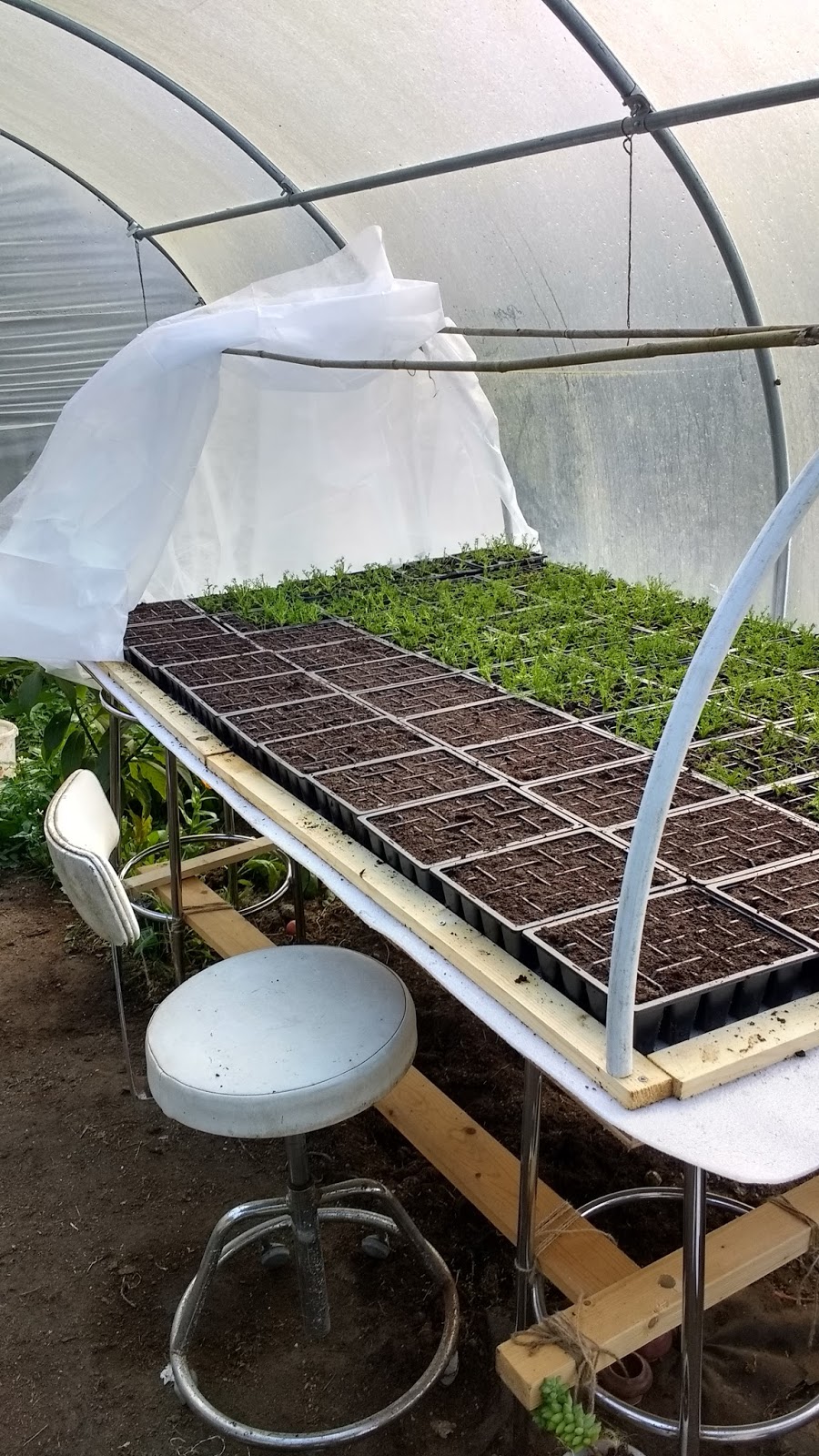
I have been making a bench and frame in the tunnel to protect my young chamomile plants. I’ve spared no expense, making the legs out of old bar stools found in a skip outside a local pub when they were having a clear out. They are stainless steel so should last the winter. I have used some marine ply for the top and covered them with the multi cell containers. For the first time ever I am going to try the horticultural fleece. It might give that little bit extra protection against the cold when I put it over the hoops I made from old plastic piping and a few screws. I think its main function will be to keep the cold wind from scorching the leaves though. I am putting some of the cuttings outside and some in the tunnel unprotected as an experiment to see if it makes any difference putting time and energy into protecting the plants. I have a few more sheets of the fleece so I can maybe use it outside, either as a cover for some tender plants or to look a bit like snow when the festive season is upon us.

Other things
I think drainage has a lot to do with plants perishing over the winter months too. Waterlogged soil does the roots no good at all and can be fatal if it freezes. Leaving old plants and green manures such as mustard on the soil can help to keep erosion to a minimum and if you access to straw this could help around perennials and keep a bit of heat in the soil.

Tuesday, November 14, 2017

Dividing Perennials


I’m clearing a few areas in the garden this week that have become overgrown. Doing this has unearthed a few perennials that have gone bald in the centre. Plants like this slowly expand along the ground leaving the old bit in the middle to die off. This is very common in lower growing perennial plants such as creeping asters. My perennial geraniums are also taking over a whole bed so are being divided too although I’m not really sure where to put them as yet.

Most perennials benefit from division every two to three years to maintain health and vigour. For the purposes of propagation, this can be done more regularly to build up stock.

These are just a few examples of plants that can be divided:, Anemone, arum lily, aster, bergenia, buttercup, daylily, delphinium, euphorbia , hosta, Iris, lily-of-the-valley , ornamental grasses, primula (primrose), sedum, verbena and sea holly,

When to divide perennials
Plants can be divided successfully at almost any time if they are kept well-watered afterwards. However, division is most successful when the plants are not in active growth.

As a general guideline, divide summer-flowering plants in spring (Mar-May) or autumn (Sep-Nov) when the soil is dry enough to work. In wet autumns, delay until spring. Spring is also better suited to plants that are a touch tender

Many spring-flowering plants, such as irises, are best divided in summer (Jun-Aug) after flowering when they produce new roots. I find that I generally divide the plants when I have the time.

Dividing perennials
Lift plants gently with a garden fork, working outwards from the crown’s centre to limit root damage. Shake off excess soil so that roots are clearly visible
Some plants, such as Ajuga (bugle), produce individual plantlets which can simply be teased out and replanted. In the case of chamomiles, these grow plantlets form the existing leaves and can be snipped off and replanted without disturbing the parent plant.
Small, fibrous-rooted plants such as Heuchera, Hosta and Epimedium can be lifted and pulled apart gently. This should produce small clumps for replanting
Large, fibrous-rooted perennials, such as Hemerocallis (daylily) require two garden forks inserted into the crown back-to-back. Use these as levers to loosen and break the root mass into two sections. Further division can then take place. You might find hostas need treating this way if they get really huge. In some cases, a sharp knife might be needed to cleave the clump in two
Plants with woody crowns (e.g. Helleborus) or fleshy roots (e.g. Delphinium) require cutting with a spade or knife. Aim to produce clumps containing three to five healthy shoots.

Dividing rhizomes.
Dig up and select young outer pieces.
Use a sharp knife to separate the rhizomes.
Select pieces that have at least one or two fans of leaves from the outside of the clump and discard the centre rhizomes.
Plants with rhizome roots include: Flag Iris, Lily of the valley and Orris Root.

Aftercare
Plant divisions as soon as possible and water them in well. Alternatively, pot up individually to build up size, overwintering pots in a frost-free environment.

Problems
There are few specific problems associated with dividing, especially if carried out between autumn and spring. However, ensure that plants don’t dry out while they do re-establish. It is also worth carrying out slug and snails control as these are often problematic pests for perennials.

Why Divide?
There are a few good reasons to divide your perennial plants:
  • Clumps have started to die out in the middle. The classic “doughnut” shape with an empty hole in the centre is a sure sign that a perennial clump needs attention.
  • Flowering performance has declined. The clump may have become congested, or the roots old and woody.
  • Soil nutrients have been exhausted around the clump. Signs of this might be stunted growth, yellowish leaves or lack of bloom. Dividing and moving to a new location is a wise idea. Sometimes simply fertilizing the plant will make it smarten up.
  • Perennial weeds like creeping buttercup or grass have infested the clumps. When this happens, usually the best approach is to dig up the entire clump and divide it, picking out every single piece of weed root that can be found.
  • Dividing established clumps can provide plenty of new plants for a new garden bed, or to share with friends and neighbours.

There are a few perennials that don’t respond well to being divided which include: Alyssums candytuft, carnation, delphinium, foxgloves, lavenders and the perennial sweet pea amongst others.
Once you start to divide plants, you will get a feel for those that will do well when divided.

More stories

Related Posts with Thumbnails